The Intelligent Mainframe: Reimagining Legacy for the AI Era with VRNeXGen
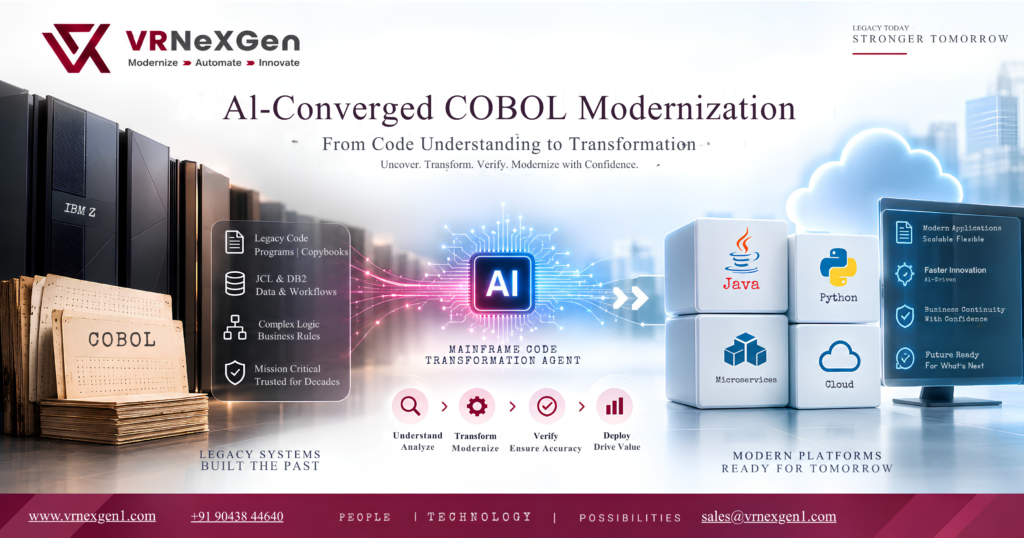
The enterprise landscape of 2026 has reached a definitive tipping point. The “cloud-first” fever that once pushed for the total abandonment of the mainframe has cooled, replaced by a more sophisticated reality: The Hybrid AI Mainframe.
For global organizations, the mainframe remains the undisputed vault of mission-critical data. However, the friction points—monolithic code, technical debt, and a shrinking pool of COBOL experts—remain.
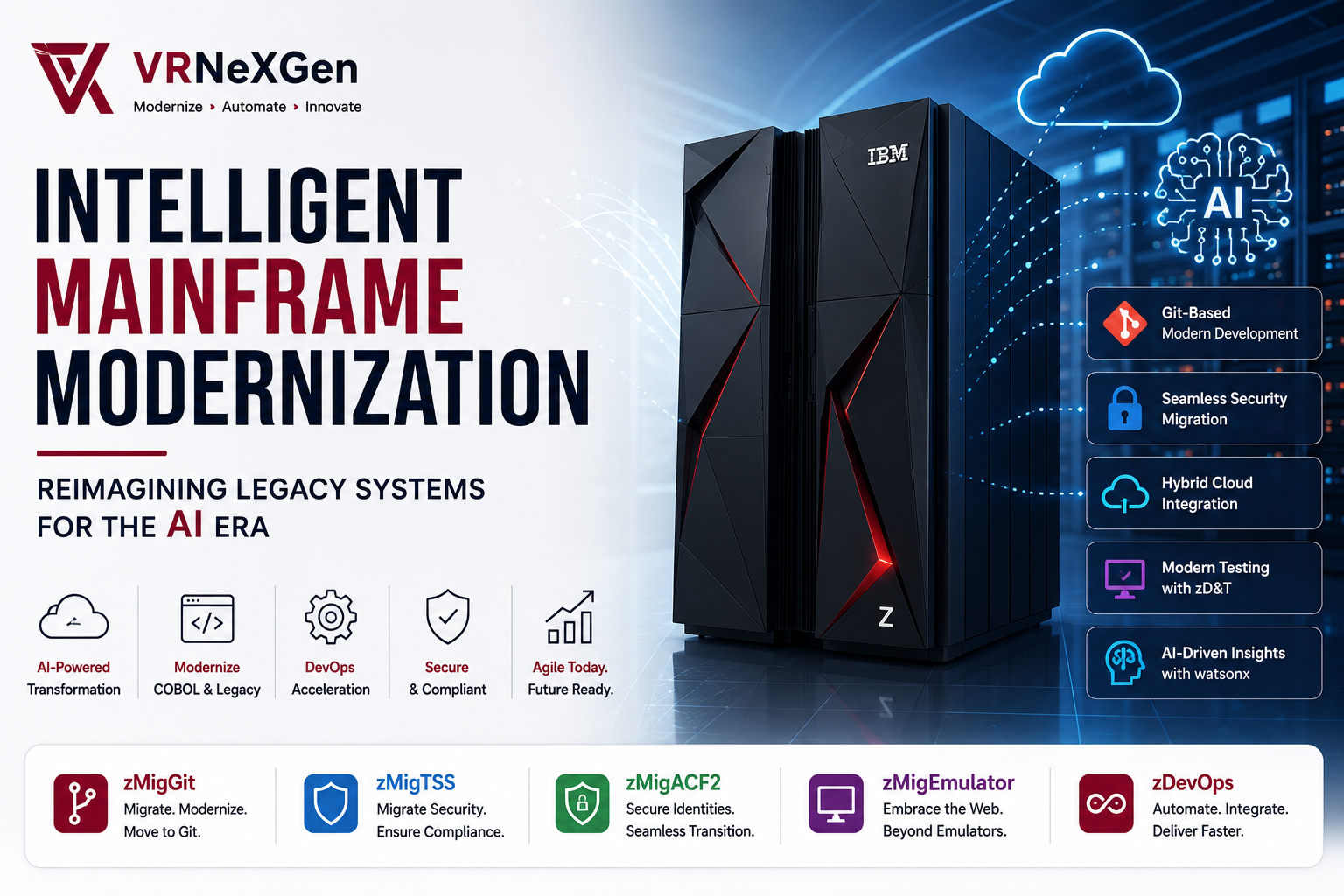
At VRNeXGen, we believe the solution isn’t to walk away from 40 years of proven reliability, but to revitalize it using our specialized toolsets: zMigGit and zDevOps accelerate complete application modernization, zMigTSS and zMigACF2 ensure seamless, secure identity migrations, and zMigEmulator effortlessly shifts your infrastructure from legacy desktop emulators to browser-based freedom.
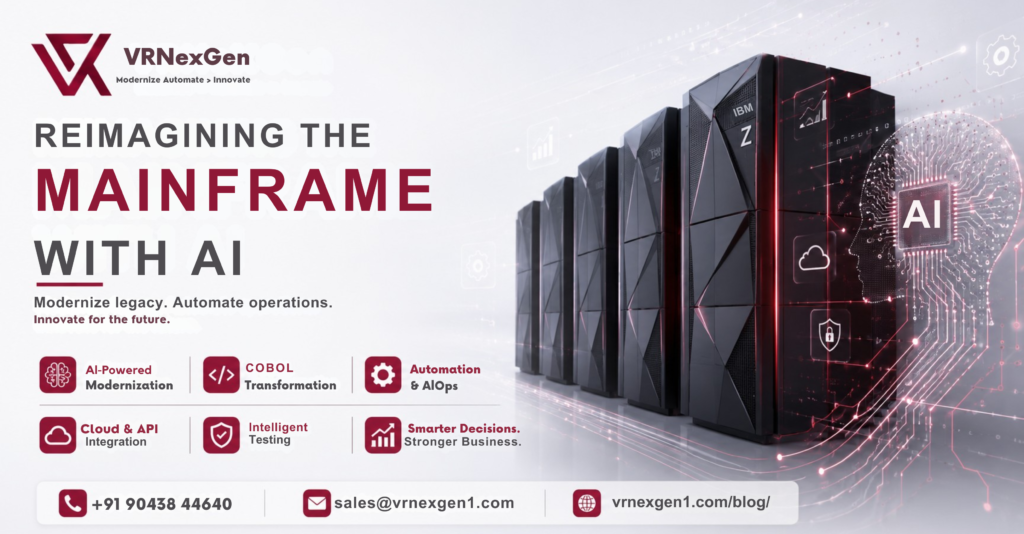
By combining VRNeXGen’s proprietary migration frameworks with the dual-engine power of GitHub Copilot and IBM watsonx.ai, we are turning legacy “black boxes” into agile, AI-driven engines of growth.
The 2026 Modernization Mandate
Modernization is no longer a technical choice; it is a business survival tactic. In an era where AI agents handle customer service and real-time fraud detection, the latency of a legacy “siloed” mainframe is a liability.
To stay competitive, your mainframe must:
- Integrate seamlesslywith Git-based DevOps pipelines.
- Expose datato AI models without risky, high-latency extracts.
- Modernize codeincrementally, rather than through high-risk “big bang” migrations.
The VRNeXGen “Triple-Threat” Architecture
At VRNeXGen, we don’t just provide consulting; we provide the tooling that automates the friction out of the transformation. Our framework is built on three pillars that solve the most common “stalling points” in modernization.
Pillar I: zMigGit – Democratizing Mainframe Development
The biggest barrier to entry for young talent is the legacy SCM (Source Code Management) system. If your code is locked in Endevor or Panvalet, it is invisible to modern tools.
- The Solution:zMigGit automates the migration of legacy assets into Git-based version control (GitHub, GitLab, or Bitbucket).
- The Impact:Once your COBOL or PL/I code is in Git, it becomes accessible to GitHub Copilot, enabling your developers to work on mainframe code with the same modern experience as a React or Python developer.
Pillar II: zMigTSS & zMigACF2 – Seamless Security Transformation
Security is the “third rail” of modernization. Changing your security manager (from CA Top Secret or ACF2 to IBM RACF) is often where projects fail due to complexity.
- The Solution:Our specialized zMigTSS and zMigACF2 frameworks automate the mapping and conversion of security rules, ensuring zero downtime and total compliance continuity.
Pillar III: Virtualization with zD&T
Modernization requires testing, and waiting for MIPS (mainframe capacity) on physical hardware is a bottleneck. We implement z/OS Development and Test Environment (zD&T) to provide virtualized, x86-based mainframe environments, allowing developers to test and break things without impacting production.
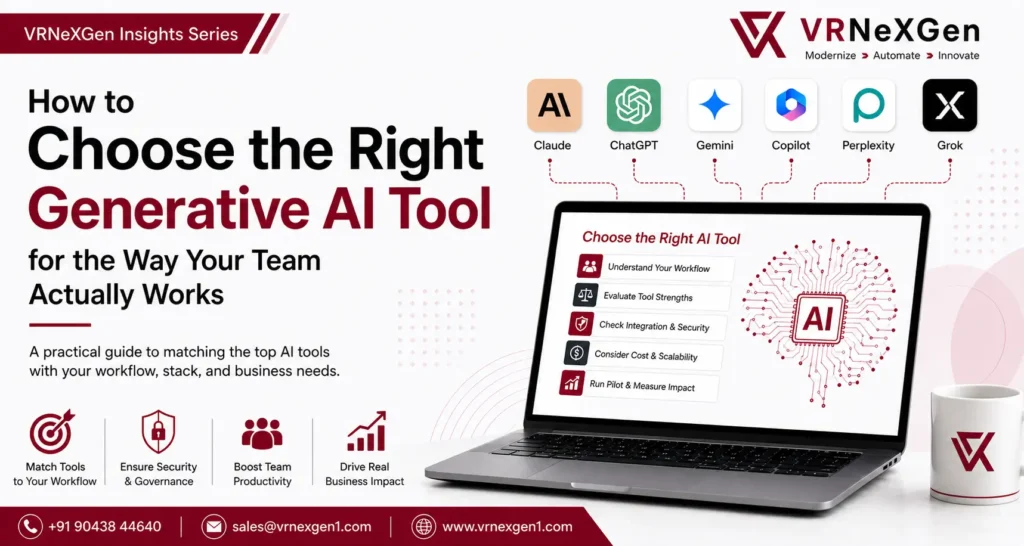
The Power of the Dual-AI Engine: Copilot + watsonx.ai
The heart of our 2026 strategy is the integration of Generative AI directly into the developer’s workflow. We use a “Best-of-Both-Worlds” approach.
GitHub Copilot: The Developer’s Real-Time Co-Pilot
GitHub Copilot has evolved. In 2026, it isn’t just about auto-completing code; it is about legacy comprehension.
- Reverse Engineering:A junior developer can highlight a complex COBOL PERFORM loop or a REDEFINES clause and ask Copilot Chat: “What is the business logic here?”
- Forward Engineering:Copilot helps translate that validated logic into modern, object-oriented Java or Python, adhering to enterprise coding standards defined in your VRNeXGen rulebook.
IBM watsonx.ai: The Architect’s Brain
While Copilot focuses on the “line of code,” watsonx.ai and the watsonx Code Assistant for Z focus on the application architecture.
- Deep Discovery:Using watsonx, we leverage Automated Discovery and Delivery Insights (ADDI) to map out the entire application topology. It sees the invisible threads connecting CICS screens to DB2 tables.
- Selective Transformation:Watsonx helps us decide what to modernize. Instead of rewriting everything, AI identifies high-value modules that should be converted to Java, while keeping low-change, high-performance logic in optimized COBOL.
Case Study: A 2026 Success Story
Recently, VRNeXGen partnered with a global financial leader struggling with a 30-year-old core banking system. They faced 6-month release cycles and rising operational risks.
The VRNeXGen Intervention:
- Discovery:Used ai to analyze 10 million lines of code, identifying that only 15% of the codebase was responsible for 80% of the maintenance headaches.
- Migration:Deployed zMigGit to move that 15% into GitHub Enterprise.
- Refactoring:We equipped the “Modernization Strike Team” with GitHub Copilot to accelerate legacy transformation. Developers leveraged Copilot to automate comprehensive documentation, generate robust test cases, and seamlessly wrap legacy modules into modern API integrations. This AI-driven approach ensured that as COBOL logic was refactored into agile API services, the core business outcomes remained perfectly identical.
- Deployment:Integrated zDevOps pipelines to automate the build and deploy process across their hybrid cloud.
The Result: Release cycles dropped from 6 months to 4 weeks. The organization didn’t just save money; they regained the ability to innovate.
Bridging the Talent Gap: Training the NeXGen
Adoption and People Transformation serve as the foundation for our modernization framework, acknowledging that technology is only as successful as the team operating it. To ensure a frictionless transition to the modern architecture, we deliver tailored, role-specific training programs:
- Application Developers:Hands-on training in VS Codium, IDz, and Git-centric development workflows.
- System Administrators:Advanced instruction on Git/Artifactory repository management and cross-regional environment access.
- Pipeline & DevOps Engineers:Deep dives into Jenkins pipelines, IBM DBB, and automated deployment configurations.
By equipping each team with role-relevant expertise, we eliminate the friction of change management and guarantee a rapid, confident adoption of modern DevOps standards.
We use GitHub Copilot as a teaching tool. By providing AI-assisted explanations of legacy code, we empower “Mainframe Interns” to become productive in weeks, not years. Our training curriculum focuses on:
- Modern IDEs:Moving from green screens to VS Code and IDz.
- AI Pair Programming:How to prompt AI to find bugs in JCL or optimize VSAM access.
- Hybrid Skills:Training developers who are equally comfortable in a COBOL Copybook as they are in a Java Class.
Conclusion: The Road Ahead
Mainframe modernization in 2026 is no longer about a “destination”—it is about continuous evolution.
At VRNeXGen, we provide the map (watsonx.ai), the vehicle (GitHub Copilot), and the fuel (our proprietary zMig toolsets). We don’t just modernize your systems; we modernize your mindset.
About VRNeXGen Technologies
Headquartered in Chennai with global operations in the USA, Singapore, and Australia, VRNeXGen is a legacy modernization firm led by industry veterans. We specialize in in-place mainframe modernization, AI integration, and enterprise training.
Contact us today for a personalized Modernization Readiness Assessment.