Introduction – z/OS System Programmer Role Explained — Responsibilities, Skills & Technical Insights
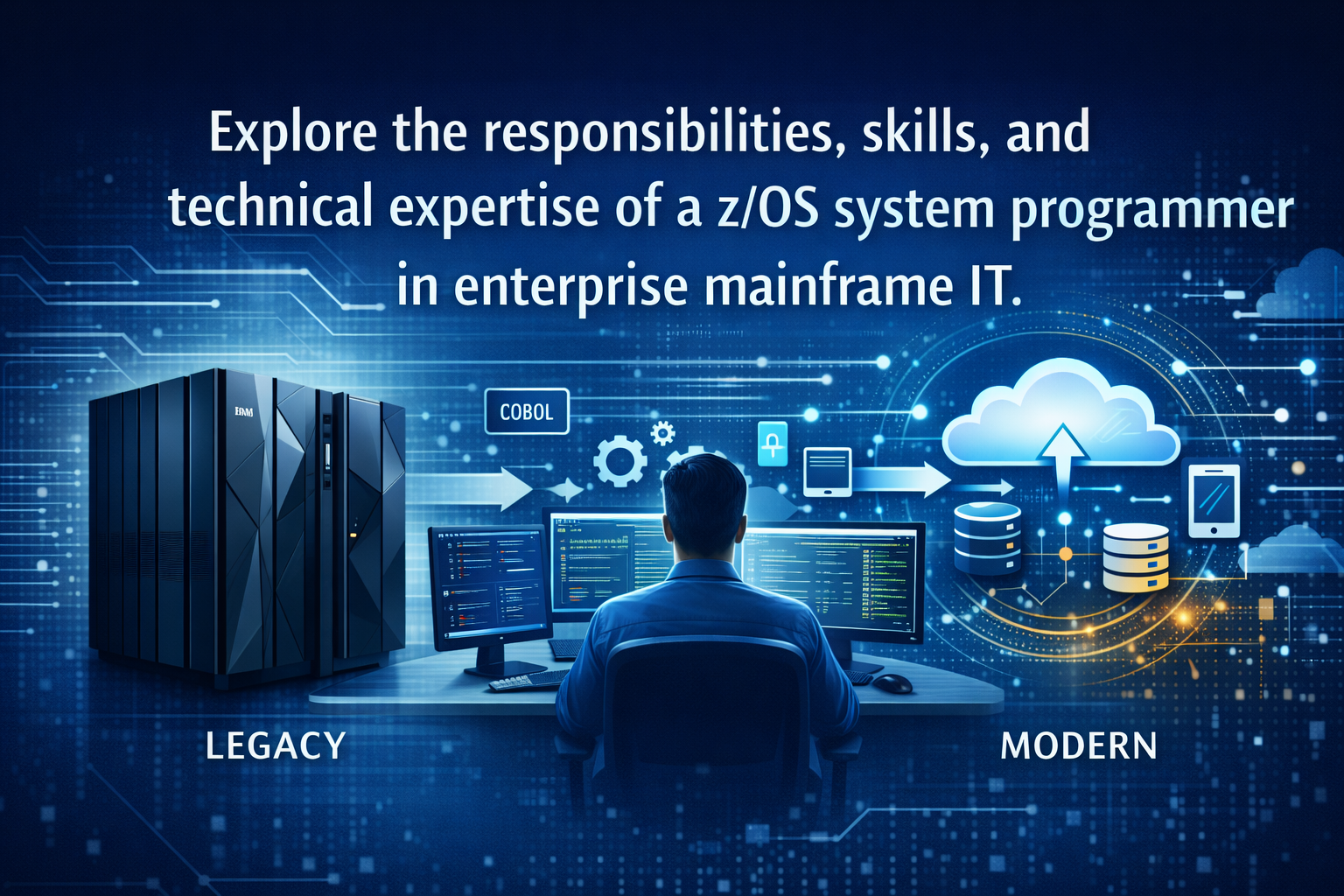
The z/OS system programmer plays a foundational role in enterprise IT environments running IBM mainframes. In industries such as banking, insurance, retail, and government, IBM z/OS systems handle high-volume, mission-critical workloads that demand stability, security, and performance. Unlike application developers, a z/OS system programmer focuses on maintaining and optimizing the mainframe operating environment itself.
This article explores the responsibilities, technical skills, daily tasks, and strategic importance of the z/OS system programmer role in modern enterprise computing.
What does the z/OS System Programmer will do?
A z/OS system programmer specializes in the installation, configuration, customization, and ongoing management of the IBM z/OS operating system. According to the official IBM documentation for z/OS (external reference: system programming includes maintaining system software, managing updates, and ensuring operational reliability.
In large enterprises, responsibilities may be segmented across subsystem specialists (CICS, DB2, IMS), but the core focus remains the same: keep the mainframe stable and aligned with business requirements.
System programmers ensure:
- System upgrades do not disrupt production
- Configuration changes meet SLA requirements
- Automation improves reliability
- Batch and online transaction processing remain highly available
Core Responsibilities of a z/OS System Programmer
1. System Installation and Customization
One of the primary mainframe system programmer responsibilities is installing and customizing the z/OS operating system and related subsystems.
This includes:
- Performing Initial Program Load (IPL)
- Managing system libraries
- Applying maintenance using SMP/E
- Ensuring compatibility with enterprise applications
Incorrect configuration can impact thousands of concurrent users, making precision essential.
Performance Tuning and Optimization
Enterprise mainframes operate under strict performance benchmarks. A z/OS system programmer monitors CPU utilization, memory allocation, I/O throughput, and workload balancing.
Tasks include:
- Adjusting system parameters
- Analyzing performance trends
- Optimizing workload distribution
- Supporting capacity planning
Performance tuning ensures that both batch jobs and online transaction systems meet expected service levels.
Troubleshooting and Problem Resolution
When performance degradation or system failures occur, the z/OS system programmer performs root cause analysis.
This may involve:
- Interpreting system dumps
- Reviewing logs and trace outputs
- Coordinating with DB2, IMS, and CICS teams
- Implementing corrective configuration changes
- Effective problem resolution protects uptime in 24×7 enterprise environments.
Security and Compliance Configuration
Security is built into the architecture of IBM mainframes. System programmers configure access controls, enforce policies, and ensure the operating system integrates with enterprise governance frameworks.
While security administrators may manage user policies, the z/OS system programmer ensures system-level compliance and audit readiness.
Daily Tasks of a z/OS System Programmer
System Health Monitoring
System programmers continuously monitor:
- System logs
- Subsystem status
- Utilization metrics
- Job queues
Tools such as SDSF and ISPF are frequently used to manage workload visibility and control.
Software Maintenance with SMP/E
Applying updates is managed through System Modification Program/Extended (SMP/E). This structured maintenance process ensures that patches are tested and applied without impacting production systems.
Proper maintenance prevents vulnerabilities and ensures compatibility with evolving enterprise applications.
Job Control Language (JCL) Management
Proficiency in Job Control Language (JCL) is fundamental. JCL defines execution parameters for batch processing in IBM mainframes.
System programmers must:
- Write and debug JCL
- Optimize job execution
- Manage workload scheduling
- Ensure resource allocation efficiency
Cross-Team Collaboration
z/OS system programmers collaborate with:
- Database administrators (DB2, IMS)
- Middleware specialists (CICS)
- Network teams
- Security teams
- Application developers
This cross-functional coordination ensures that system changes align with enterprise IT strategy.
Tools and Technologies Used in z/OS System Programming
Key technologies include:
- SMP/E for patch and fix management
- SDSF for job and system monitoring
- ISPF for interactive operations
- JES for workload and batch management
- JCL for execution control
Mastery of these tools differentiates experienced system programmers from operational administrators.
Required Skills for a z/OS System Programmer
Deep Understanding of z/OS Internals
A strong grasp of z/OS architecture, IPL processes, memory management, and subsystem integration is mandatory.
Advanced JCL Expertise
Because batch processing remains central to enterprise computing, JCL knowledge is non-negotiable.
Diagnostic and Analytical Skills
System programmers must interpret system dumps, logs, and performance metrics to identify root causes without introducing secondary risks.
Communication and Collaboration
Given the interconnected nature of mainframe environments, effective communication with operations, development, and security teams is critical.
Industry Demand and Career Outlook
Despite predictions of mainframe decline, IBM z/OS continues to power high-value enterprise systems worldwide. Financial institutions, government agencies, and large retailers depend on mainframes for transaction integrity and uptime guarantees.
The demand for skilled z/OS system programmers remains strong due to:
- Aging workforce
- Skills shortage
- Increasing modernization initiatives
- Hybrid cloud integration efforts
Organizations investing in mainframe modernization rely heavily on system programmers to support integration and automation initiatives.
For a practical overview of the z/OS system programmer role, watch this detailed video explanation: https://www.youtube.com/watch?v=GsL9_Affq0g&t=1s