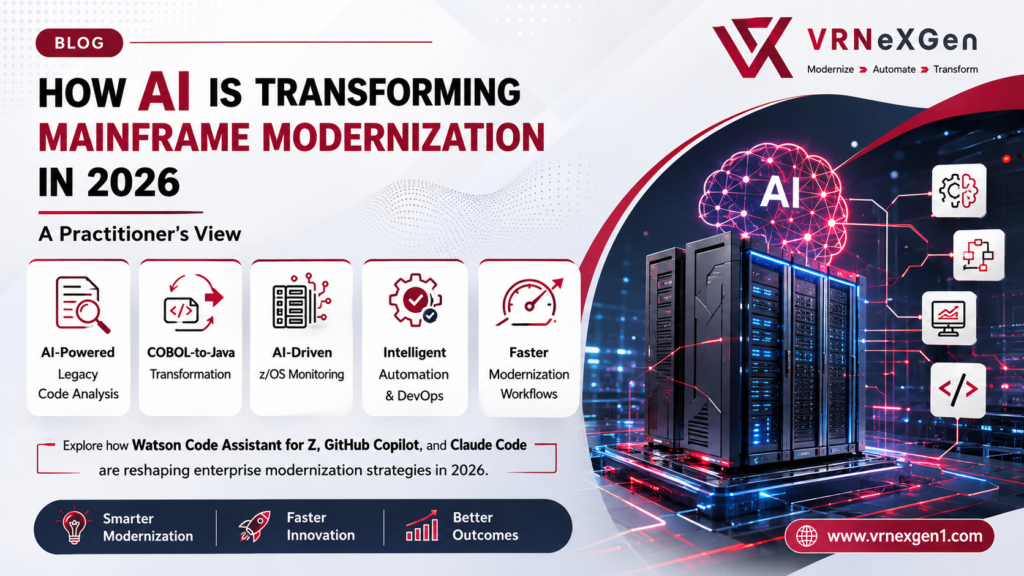
How AI Is Transforming Mainframe Modernization in 2026 — A Practitioner's View
Introduction
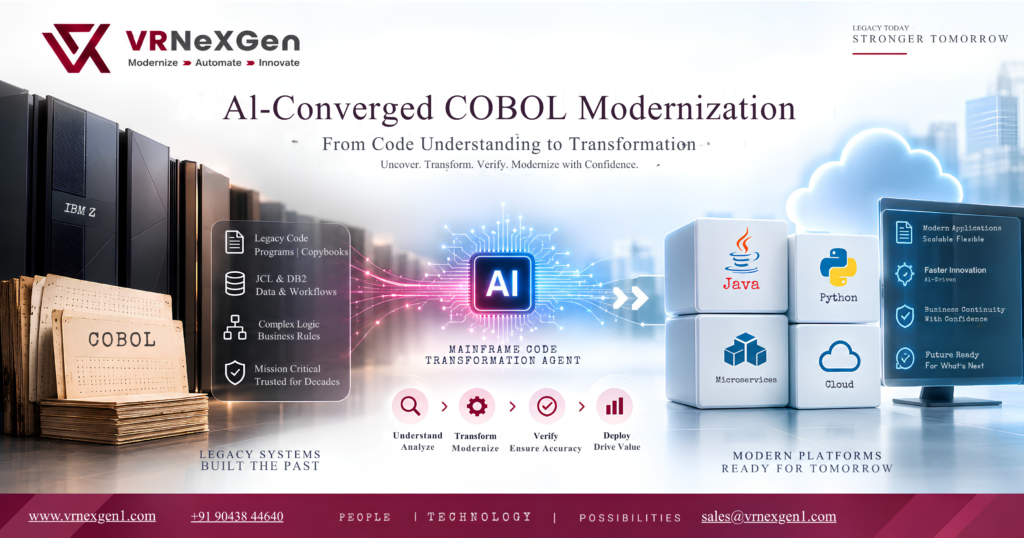
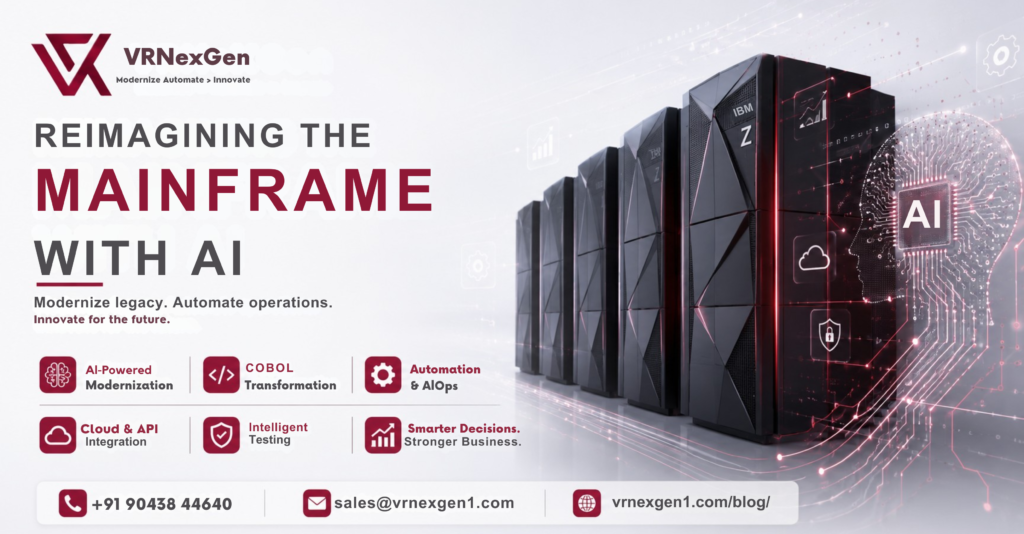
Artificial Intelligence has moved from being a buzzword in enterprise IT to becoming an everyday companion on the mainframe modernization journey. In 2026, organizations that once viewed their z systems as untouchable legacy estates are now actively pairing them with AI assistants, automated pipelines, and intelligent monitoring platforms to deliver modernization outcomes faster and with far less risk.
What makes this shift different from previous waves of modernization is how directly AI now touches the daily work of mainframe developers, architects, and operations teams. It is no longer a future-state slide in a strategy deck — it is sitting inside the IDE, the pipeline, and the operations dashboard.
At VRNeXGen, modernization engagements are increasingly built around this practical, tool-driven application of AI across the full mainframe lifecycle.
What Is AI-Driven Mainframe Modernization?
AI-driven mainframe modernization is the use of intelligent tooling — large language models, code assistants, predictive analytics engines, and automation platforms — to transform how legacy systems are understood, changed, deployed, and operated.
In practical terms, this means AI now contributes to:
- Reading and explaining legacy COBOL, PL/I, JCL, and Assembler
- Generating new code and unit tests
- Converting legacy programs into modern languages
- Orchestrating CI/CD pipelines spanning z and distributed platforms
- Monitoring z/OS health and predicting failures
- Generating business insights from mainframe-resident data
Rather than replacing the mainframe, AI is unlocking it.
Why AI Matters for Mainframe Modernization
The traditional pain points of mainframe estates — large undocumented codebases, shrinking COBOL skill pools, slow change cycles, and limited integration with modern channels — are exactly the problems AI is best positioned to solve. Used correctly, AI compresses analysis time, fills documentation gaps, and gives modernization teams the confidence to move faster without breaking critical workloads.
How AI Is Transforming Mainframe Modernization — A Practitioner’s View
The following are seven areas where AI is already making a measurable difference in real modernization programs.
1. Legacy Code Analysis with AI Assistants
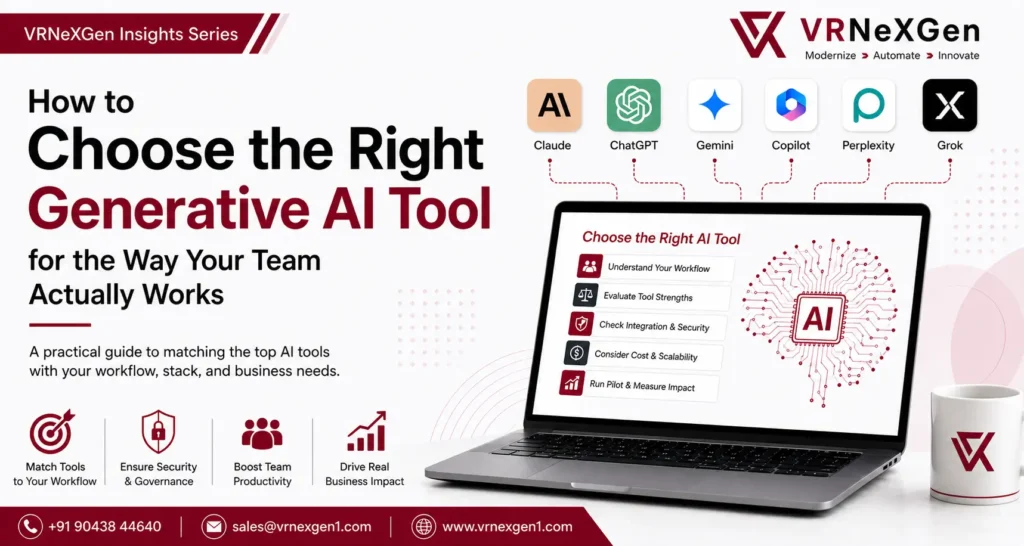
Tools like IBM Watson Code Assistant for Z, GitHub Copilot, and Claude Code have become indispensable for working with decades-old codebases. In practice, they support the most time-consuming activities in any modernization program:
- Code analysis— quickly understanding what a 5,000-line COBOL program actually does, including its paragraphs, performs, and conditional flows.
- Code documentation— generating readable explanations, flow descriptions, and inline comments for programs that were never properly documented.
- Business rule extraction— surfacing the embedded logic, calculations, and decision rules that are scattered across COBOL paragraphs and copybooks, so they can be cataloged and reused.
- Impact analysis— tracing how a change in one program, copybook, or DB2 table will ripple across the wider application landscape.
- Change implementation— suggesting the actual code edits, with awareness of the surrounding program structure and coding standards.
What used to take a senior developer days of manual reading now takes hours, with the AI acting as a tireless first-pass analyst.
2. Code Generation with the Right Prompts
When given well-structured prompts, tools like GitHub Copilot and Claude Code can generate substantial portions of working code — COBOL paragraphs, JCL steps, REXX utilities, Java services, unit tests, and even DB2 SQL.
The real skill here is prompt engineering for the mainframe context: specifying the language dialect, the coding standard, the input copybooks, the expected behavior, and the integration touchpoints. With the right prompt, AI moves from “autocomplete” to “co-developer,” producing code that genuinely shortens delivery cycles instead of just saving keystrokes.
3. Eclipse-Based Editors with Smart Templates and Auto-Correction
Modern Eclipse-based IDEs — IBM Developer for z/OS (IDz), Wazi, and similar — have absorbed AI capabilities directly into the developer experience. Code templates accelerate the creation of standard structures like file handling, error routines, and DB2 access. Automatic code correction flags syntax issues, deprecated constructs, and standards violations as the developer types.
For teams shifting from green-screen ISPF to modern editors, this combination of templates and AI-assisted correction dramatically lowers the learning curve and improves first-time code quality.
4. COBOL-to-Java Code Conversion
One of the most discussed use cases of AI in modernization is converting COBOL programs into Java. AI-assisted conversion goes beyond simple syntax translation — it preserves business logic, restructures procedural code into object-oriented designs, and produces Java that is readable and maintainable rather than mechanical.
In practical engagements, this is rarely a one-click activity. The AI does the heavy lifting of producing a strong first-cut Java equivalent, while engineers focus on refining structure, validating business rules, and reworking the data access layer. The result is a modernization path that is both faster and more reliable than fully manual rewrites.
5. CI/CD Pipeline Orchestration with Automation
AI is now a core part of modern mainframe DevOps (zDevOps) pipelines. Tools like Jenkins, GitLab, Azure DevOps, and IBM Z DevOps Acceleration Program tooling are increasingly augmented with AI to:
- Automate build, test, and deploy steps across z/OS and distributed targets
- Trigger intelligent test selection based on changed components
- Generate or update pipeline configurations from natural-language descriptions
- Detect pipeline failures and suggest fixes
The outcome is a unified, automated delivery flow where mainframe changes move through the same disciplined CI/CD lifecycle as cloud-native workloads.
6. AI-Based Dashboards for z System Monitoring
On the operations side, AI-driven dashboards are transforming how z/OS environments are monitored. Instead of reacting to SMF records and console alerts after the fact, teams now use AI-powered observability platforms that:
- Correlate metrics across CPU, storage, DB2, CICS, and IMS
- Detect anomalies in workload behavior before they breach thresholds
- Predict capacity and performance issues hours or days in advance
- Recommend tuning actions and automate routine responses
This shift from reactive to proactive operations is one of the most tangible wins of AI in the mainframe space — fewer incidents, better SLAs, and a calmer on-call rotation.
7. AI-Driven Data Insights and Forecasting for Banking Applications
Mainframes still host a large share of the world’s banking transactions, which makes them a natural source of high-value data. AI is now being applied directly on top of this data to deliver:
- Customer behavior analytics on transaction histories
- Fraud detection and anomaly scoring on payment streams
- Cash flow and liquidity forecasting
- Credit risk modeling using long-horizon historical data
- Branch-level and product-level demand forecasting
By combining mainframe-resident data with AI models — often through a hybrid pattern where z systems serve as the system of record and AI runs alongside on cloud or Linux on Z — banks can extract forward-looking insights without disrupting core systems.
Benefits of AI in Mainframe Modernization
Across these seven areas, the benefits show up consistently:
- Faster delivery— analysis, coding, conversion, and deployment all accelerate.
- Lower cost— reduced manual effort and better-targeted modernization.
- Higher quality— AI-assisted reviews, tests, and standards enforcement.
- Improved agility— modern pipelines and IDEs unlock continuous change on the mainframe.
- Proactive operations— predictive monitoring instead of reactive firefighting.
- Better business outcomes— actionable insights drawn directly from core banking and enterprise data.
Industries Seeing the Biggest Impact
The sectors with the largest legacy z footprints are also the ones gaining the most from AI-driven modernization: banking and financial services, insurance, healthcare, government, and large-scale manufacturing. These industries cannot afford to disrupt their cores, which is exactly why AI-assisted, incremental modernization fits them so well.
The Road Ahead
Looking beyond 2026, the direction is clear. AI assistants will move deeper into the IDE and pipeline, COBOL-to-Java conversion will mature into a near-routine activity for selected workloads, and AIOps platforms will take on more autonomous responsibility for z/OS health. The mainframe is not going away — it is becoming an AI-augmented platform that sits comfortably alongside cloud and modern application stacks.
Conclusion
AI is reshaping mainframe modernization in very concrete ways: inside the editor with Watson Code Assistant for Z, Copilot, and Claude Code; inside the pipeline with automated CI/CD; inside the operations console with predictive dashboards; and inside the business with data-driven forecasting. For organizations willing to apply these tools thoughtfully, the result is a mainframe estate that is modern, observable, and a real contributor to enterprise innovation.
At VRNeXGen, modernization programs are built around exactly this kind of practical, tool-driven AI adoption — helping enterprises optimize, automate, and innovate across their mainframe landscape.
Ready to modernize your mainframe with AI-driven innovation?
Discover how AI tools like Watson Code Assistant for Z, GitHub Copilot, and Claude Code are transforming enterprise modernization in 2026.
📩 Get in touch with VRNeXGen Technologies to accelerate your modernization journey.
🌐 www.vrnexgen1.com
📧 sales@vrnexgen1.com
📞 +91 90438 44640