
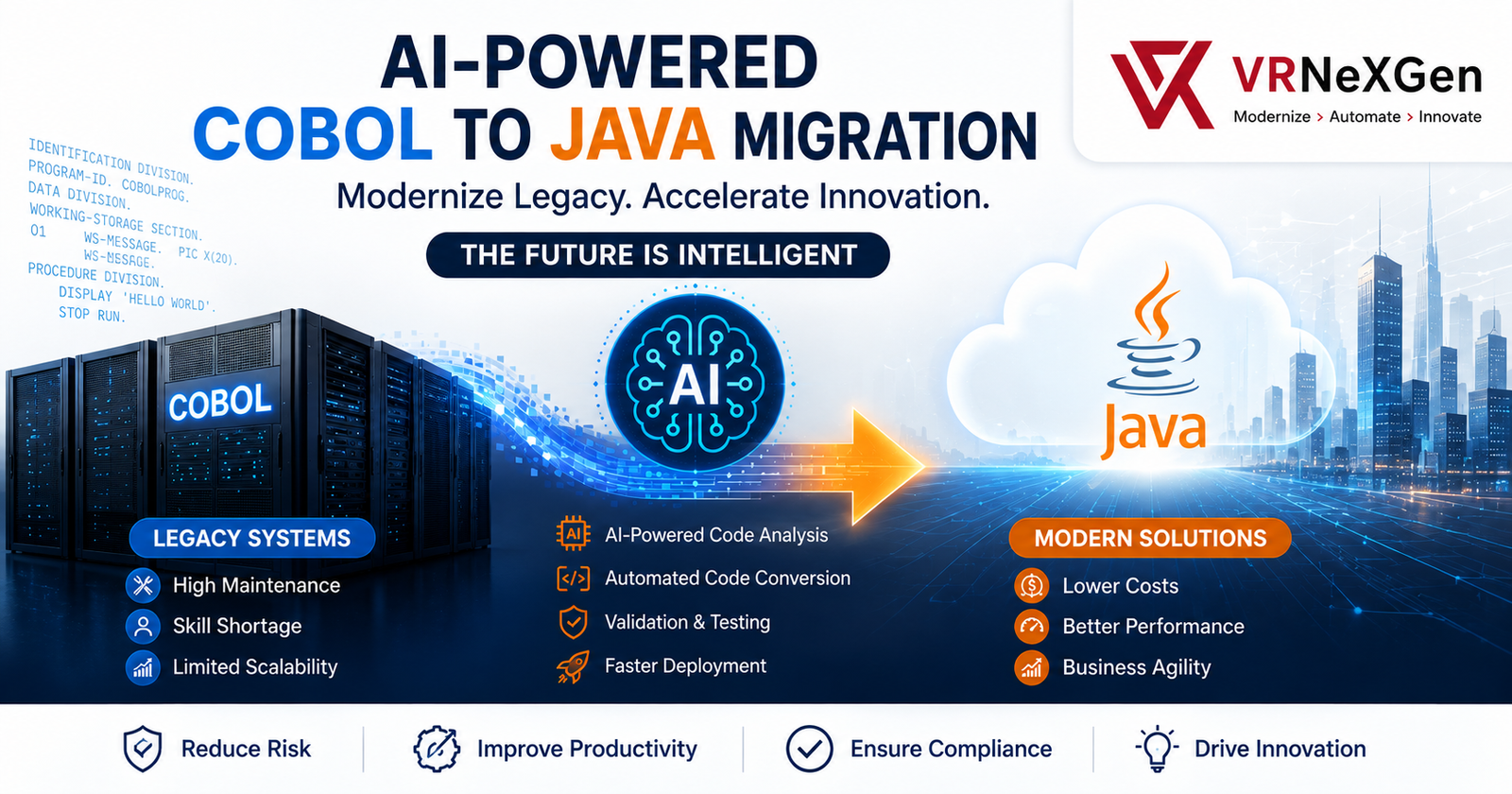
AI-Powered COBOL to Java Migration in 2026
Introduction
AI-Powered COBOL to Java Migration is rapidly transforming enterprise modernization strategies in 2026. Organizations running critical workloads on legacy mainframes are under increasing pressure to modernize aging COBOL applications while reducing operational costs, improving scalability, and accelerating digital transformation initiatives.
Traditional COBOL modernization projects often require years of manual analysis, code refactoring, testing, and documentation. However, with advances in Generative AI, enterprises can now automate significant portions of the migration lifecycle. AI-driven modernization platforms use machine learning, natural language processing, and code intelligence to analyze legacy COBOL systems and convert them into scalable Java-based applications.
In real-world enterprise modernization projects, the migration journey usually starts with a detailed assessment of the existing mainframe ecosystem. During the initial analysis phase, organizations often use IBM Z Asset Analyzer to identify active products, applications, subsystems, and software components currently running in the environment. This helps modernization teams clearly understand which applications are truly active, business-critical, and part of the current production workload before planning migration activities.
As enterprises prioritize cloud-native architectures, API integrations, and hybrid infrastructure, AI-Powered COBOL to Java Migration has emerged as one of the most strategic modernization initiatives for banks, insurance providers, healthcare systems, and government organizations.
This guide explains how AI-powered migration works, why COBOL modernization matters, the role of Generative AI, risk mitigation strategies, and the best enterprise modernization framework for 2026.
Why AI-Powered COBOL to Java Migration Matters in 2026
Many enterprises still rely on COBOL applications developed decades ago. These systems continue to process mission-critical transactions but present major operational challenges, including:
- Limited developer availability
- High maintenance costs
- Poor integration capabilities
- Legacy infrastructure dependency
- Slow innovation cycles
- Compliance and security risks
AI-Powered COBOL to Java Migration enables organizations to modernize without completely rebuilding applications from scratch.
Modernization Benefit | Impact |
Faster Development | Accelerates release cycles |
Cloud Compatibility | Enables hybrid cloud deployment |
API Integration | Improves interoperability |
AI Automation | Reduces manual coding efforts |
Improved Scalability | Supports modern workloads |
Reduced Technical Debt | Simplifies long-term maintenance |
Modern Java ecosystems provide better support for DevOps automation, containerization, microservices, and enterprise integration frameworks. Migrating COBOL workloads to Java also improves compatibility with Kubernetes, REST APIs, and modern observability platforms.
How AI-Powered COBOL to Java Migration Works
AI-Powered COBOL to Java Migration combines Generative AI, static code analysis, dependency mapping, and automated testing to streamline the modernization lifecycle.
AI-Powered COBOL to Java Migration Assessment Phase
The first step involves analyzing the existing COBOL environment.
AI-based tools scan:
- COBOL source code
- JCL scripts
- DB2 dependencies
- VSAM files
- CICS transactions
- Batch processing logic
The AI engine identifies:
- Business rules
- Application dependencies
- Dead code
- Reusable modules
- Data structures
- Security risks
In many enterprise client engagements, teams also leverage ADDI (Application Discovery and Delivery Intelligence) when available in the customer environment. ADDI helps perform deep application inventory analysis, dependency mapping, business rule extraction, and end-to-end application understanding. This significantly improves modernization planning and reduces dependency-related surprises during migration.
If ADDI is not available, modernization teams increasingly use modern developer tooling such as VS Code integrated with AI coding assistants like Claude Code and GitHub Copilot. These tools help accelerate legacy code analysis, documentation generation, impact assessment, and business logic understanding for large COBOL applications.
This automated discovery and analysis phase significantly reduces manual documentation efforts and improves migration accuracy.
Generative AI for AI-Powered COBOL to Java Migration
Generative AI models play a critical role in transforming legacy applications into modern Java architectures.
AI engines can:
- Convert COBOL syntax into Java code
- Generate API-ready services
- Create documentation automatically
- Refactor business logic
- Recommend modernization patterns
- Optimize database queries
In practical modernization projects, enterprises commonly evaluate multiple approaches for COBOL-to-Java transformation depending on application complexity, budget, governance requirements, and modernization timelines.
Some of the widely adopted approaches include:
Watsonx Code Assistant for Z
AI platforms such as IBM Watsonx Code Assistant for Z help automate COBOL to Java conversion using enterprise-grade Generative AI capabilities. These platforms assist developers in:
- Converting COBOL business logic into Java
- Generating explainable documentation
- Simplifying code understanding
- Accelerating refactoring activities
- Reducing manual modernization effort
This approach is especially useful for large-scale enterprise modernization programs where governance, consistency, and scalability are critical.
Custom AI-Based Conversion Frameworks
Some organizations also build custom modernization accelerators using AI models combined with automation scripts and rule-based conversion frameworks. These custom solutions are designed based on project-specific requirements and may include:
- AI-assisted code translation
- Custom parsing engines
- Automated code restructuring
- Business rule extraction
- Java template generation
- Batch conversion automation
This approach gives enterprises more flexibility to tailor modernization workflows according to their internal standards and target architecture requirements.
For example, AI can transform monolithic COBOL modules into modular Java microservices while preserving business functionality.
Generative AI also helps developers understand legacy logic that may no longer have proper documentation.
AI-Powered COBOL to Java Migration Testing Automation
Testing is one of the most resource-intensive phases of modernization.
AI-driven testing platforms automate:
- Regression testing
- Functional validation
- Test case generation
- Data reconciliation
- Performance testing
- Security validation
This reduces modernization risk and improves migration accuracy.
Automated testing frameworks also help ensure that migrated Java applications produce identical business outcomes compared to legacy COBOL systems.
Manual vs AI-Powered COBOL to Java Migration
Enterprises increasingly compare traditional modernization methods with AI-driven approaches.
Migration Factor | Manual Migration | AI-Powered Migration |
Code Analysis | Manual review | Automated discovery |
Documentation | Time-consuming | AI-generated |
Conversion Speed | Slow | Accelerated |
Testing Effort | High | Automated |
Error Rate | Higher | Reduced |
Scalability | Limited | Enterprise-scale |
Cost Efficiency | Expensive | Optimized |
Traditional modernization projects often take several years. AI-Powered COBOL to Java Migration can reduce project timelines by 40% to 60% depending on system complexity.
AI-Powered COBOL to Java Migration Risks and Compliance
Despite the advantages of AI-driven modernization, enterprises must address several risks during migration.
Data Integrity Risks in AI-Powered COBOL to Java Migration
Legacy systems often contain decades of business-critical transactional data.
Migration challenges include:
- Data mapping inconsistencies
- Schema transformation issues
- Encoding mismatches
- Batch process synchronization
Enterprises should implement automated data validation frameworks to ensure accuracy.
Compliance Challenges in AI-Powered COBOL to Java Migration
Industries such as banking and healthcare operate under strict regulatory frameworks.
Migration projects must maintain compliance with:
- GDPR
- HIPAA
- PCI DSS
- SOX
- Financial audit requirements
AI-powered governance tools can help monitor compliance throughout the migration lifecycle.
Security Considerations for AI-Powered COBOL to Java Migration
Security remains a top modernization priority.
Organizations should implement:
- Zero-trust security models
- Identity and access management
- API security controls
- Encryption standards
- Continuous vulnerability scanning
Modern Java architectures provide stronger integration with enterprise security frameworks compared to legacy environments.
Best Strategy for AI-Powered COBOL to Java Migration
Successful modernization requires a phased enterprise strategy.
Step 1: Application Portfolio Assessment
Identify:
- Critical workloads
- High-risk applications
- Integration dependencies
- Modernization priorities
AI assessment tools such as Z Asset Analyzer and ADDI can significantly accelerate portfolio discovery and dependency analysis.
Step 2: Prioritize AI-Powered COBOL to Java Migration Candidates
Not all applications require immediate modernization.
Focus first on:
- High-maintenance systems
- Customer-facing applications
- Compliance-sensitive workloads
- Frequently updated platforms
Step 3: Implement Hybrid Modernization
Many enterprises adopt hybrid modernization strategies.
This includes:
- Retaining core mainframe processing
- Migrating selected services to Java
- Integrating APIs gradually
- Modernizing in phases
Hybrid approaches reduce operational disruption.
Step 4: Automate AI-Powered COBOL to Java Migration Pipelines
Modernization pipelines should include:
- AI code conversion
- CI/CD automation
- Automated testing
- Security validation
- Cloud deployment workflows
Organizations also increasingly integrate AI-powered development environments such as VS Code with GitHub Copilot or Claude Code into modernization pipelines to improve developer productivity and speed up documentation, code remediation, and migration analysis activities.
Automation improves scalability and reduces human error.
Step 5: Continuous Optimization After AI-Powered COBOL to Java Migration
Modernization is not a one-time project.
Organizations should continuously optimize:
- Application performance
- Cloud resource usage
- Security posture
- API integrations
- Observability systems
AI-powered analytics platforms can monitor performance continuously.
Future of AI-Powered COBOL to Java Migration
The future of enterprise modernization is increasingly AI-driven.
Emerging trends include:
- Autonomous code conversion
- AI modernization copilots
- Self-healing migration pipelines
- AI-generated documentation
- Predictive modernization analytics
- Intelligent workload optimization
As Generative AI models become more advanced, enterprises will automate larger portions of the modernization lifecycle.
AI-Powered COBOL to Java Migration will continue to play a central role in enterprise digital transformation strategies throughout 2026 and beyond.
Conclusion
AI-Powered COBOL to Java Migration is redefining enterprise modernization by combining Generative AI, automation, and cloud-native transformation strategies. Organizations modernizing legacy COBOL systems can reduce operational complexity, accelerate innovation, and improve long-term scalability through AI-driven migration frameworks.
In practical enterprise modernization projects, organizations increasingly rely on tools such as IBM Z Asset Analyzer for environment assessment, ADDI for application inventory and dependency analysis, VS Code with AI coding assistants for documentation and code understanding, and enterprise AI platforms like Watsonx Code Assistant for Z for accelerated COBOL-to-Java transformation.
Compared to traditional modernization methods, AI-powered approaches significantly reduce project timelines, automate testing, improve code conversion accuracy, and lower modernization risk.
As enterprises continue investing in hybrid cloud architectures, API ecosystems, and intelligent automation, AI-Powered COBOL to Java Migration will become a foundational technology strategy for future-ready digital infrastructure.
Businesses that adopt AI-driven modernization today will gain a competitive advantage through faster transformation, improved operational resilience, and scalable enterprise innovation.
Modernize Your Legacy Systems with VRNeXGen Today!
Accelerate COBOL to Java migration using AI-powered automation, faster transformation, and cloud-ready modernization solutions.
🌐 www.vrnexgen1.com
📧 sales@vrnexgen1.com
📞 +91 90438 44640
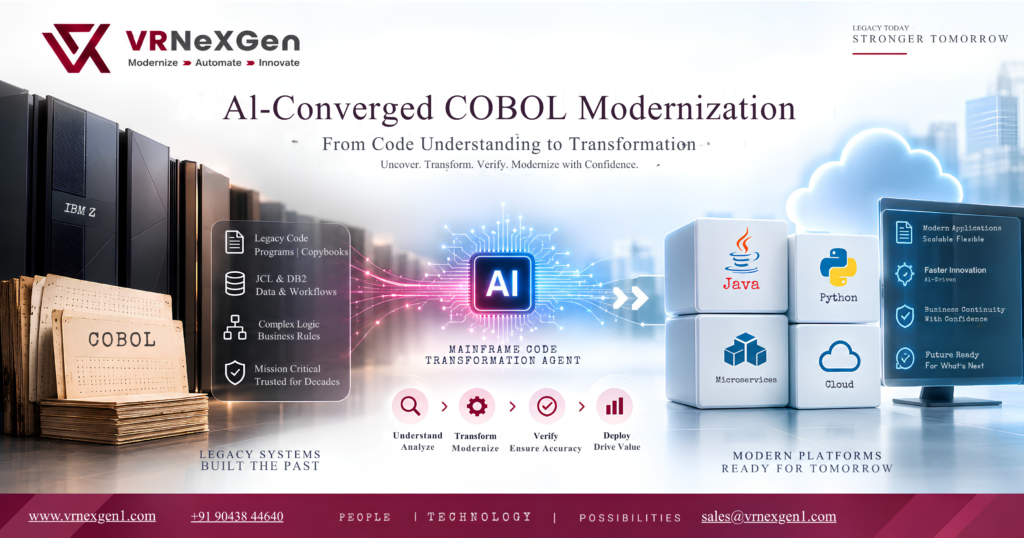




[…] a Mainframe Code Transformation Agent moves legacy COBOL to Java microservices or Python — and why verification, not translation, is the hard […]