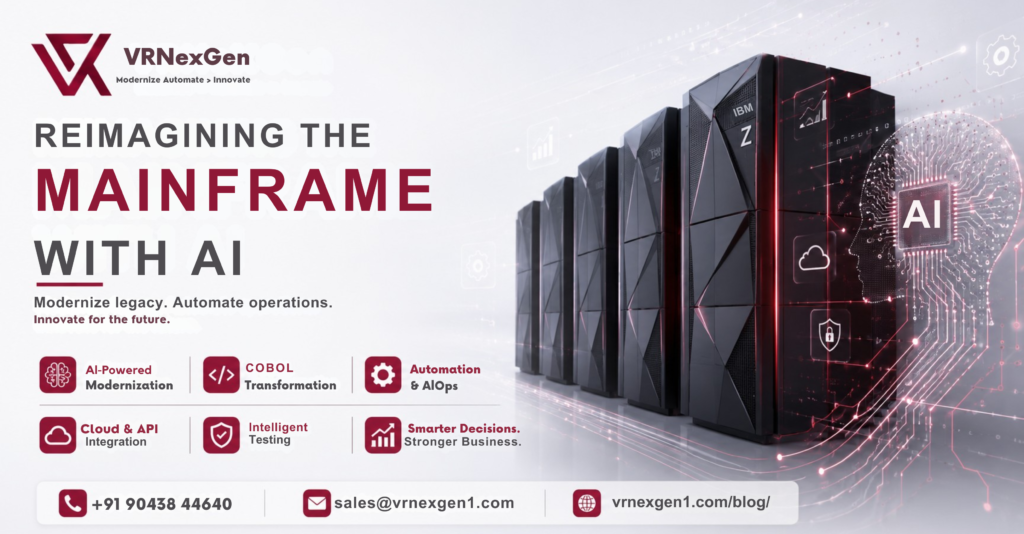
AI-Powered Mainframe Modernization: Reimagining the Mainframe with AI from Legacy to Intelligent Enterprise
For decades, the mainframe has been the backbone of some of the world’s most critical businesses. Banking, financial services, insurance, healthcare, retail, airlines and government organizations continue to depend on IBM Z systems to process millions of transactions securely, reliably and at scale.
Yet the role of the mainframe is changing.
Organizations are no longer asking whether the mainframe should survive. The more important question is:
How can enterprises transform the mainframe into a modern, intelligent and AI-enabled platform while protecting the business value embedded in decades of existing applications?
This is where AI-powered Mainframe Modernization is emerging as a strategic opportunity.
Modernization is no longer simply about rewriting COBOL applications or moving workloads away from the mainframe. It is about combining the strength of the existing platform with modern engineering practices, APIs, DevOps, automation, cloud integration, data and Artificial Intelligence.
The future is not necessarily mainframe versus modern technology.
It is about creating a modern mainframe ecosystem.
AI-Powered Mainframe Modernization: The Mainframe Modernization Challenge
Many enterprises have thousands of applications, millions of lines of COBOL, complex JCL, CICS transactions, DB2 databases, VSAM files and decades of business rules running on z/OS.
These applications represent enormous business knowledge.
A complete rewrite can be expensive, risky and time-consuming. At the same time, simply maintaining legacy applications without modernization can create challenges around skills, development speed, integration and innovation.
This creates a fundamental modernization dilemma:
How do organizations modernize without losing the reliability and business knowledge already embedded in their mainframe applications?
The answer requires a structured modernization strategy.
Instead of treating modernization as a single migration project, enterprises should look at it as a journey involving several dimensions:
- Application modernization
- COBOL transformation
- DevOps and Git adoption
- API and digital integration
- Intelligent testing
- AIOps and automation
- Modernization decision frameworks
- AI-enabled skills and operating models
AI can become an important accelerator across each of these areas.
1. AI-Powered Mainframe Modernization: Strategy, Roadmap & the Future of COBOL
The first step in modernization is not technology.
It is strategy.
Organizations need to understand their existing application landscape before deciding what should be modernized, migrated, rewritten, refactored or retained.
AI can help enterprises analyze large application portfolios by identifying application dependencies, business functions, code complexity, technical debt and potential modernization candidates.
Instead of spending months manually analyzing thousands of programs, AI-assisted tools can help teams understand application relationships and generate insights faster.
A successful modernization strategy should therefore begin with:
Discover → Assess → Analyze → Prioritize → Modernize → Validate → Operate
The objective is not to modernize everything.
The objective is to modernize the right things, in the right sequence, for the right business outcome.
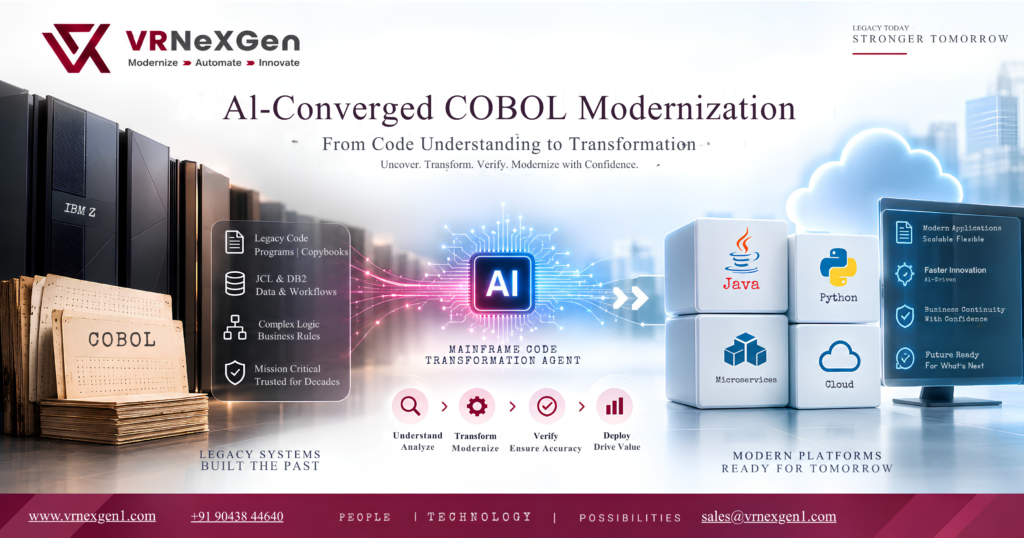
2. AI-Powered COBOL Modernization: From Code Understanding to Transformation
COBOL remains one of the most important technologies in enterprise computing.
The challenge is not simply the programming language itself. The real complexity lies in understanding the business logic accumulated over decades.
A COBOL program may contain rules that are not documented anywhere else.
AI can help developers understand this hidden knowledge.
AI-assisted development can support activities such as:
- COBOL code explanation
- Program summarization
- Business-rule identification
- Dependency analysis
- Data-flow analysis
- Code documentation
- Impact analysis
- Test-case generation
- Code transformation assistance
This changes the role of modernization teams.
Instead of starting with:
“How do we rewrite this COBOL application?”
teams can ask:
“What business capability does this application provide, and what is the best modern architecture for delivering that capability?”
This distinction is critical.
In some cases, COBOL may remain the best implementation technology. In others, specific components may be exposed as APIs, refactored into services or transformed into another language.
AI provides another layer of intelligence to make those decisions.
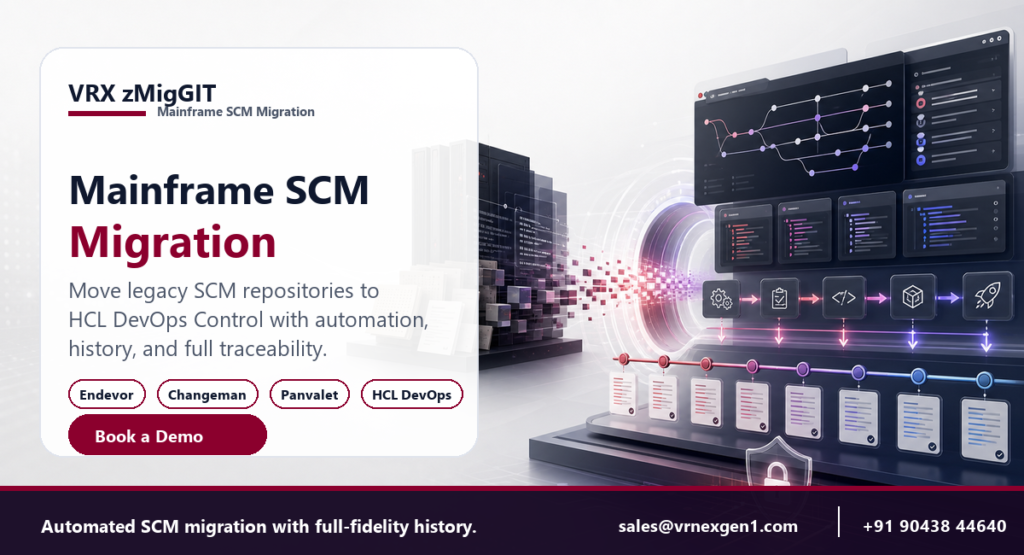
3. From Legacy to Git: Building a Modern Mainframe DevOps Pipeline
Modernization cannot succeed with modern code alone.
The development process itself must evolve.
Traditional mainframe development often depends on established source-control systems, manual promotion processes and environment-specific procedures.
Modern engineering practices introduce:
- Git-based source management
- CI/CD pipelines
- Automated builds
- Automated testing
- Code reviews
- Pull requests
- Infrastructure automation
- DevSecOps practices
- Deployment automation
Bringing Git and DevOps practices into the mainframe environment allows mainframe developers to participate in enterprise-wide engineering processes.
Tools and technologies such as Git, VS Code, IBM DBB, Zowe and CI/CD platforms can help create a development experience that connects mainframe engineering with modern software delivery.
The goal is not simply “move mainframe source code into Git.”
The real objective is to create a repeatable engineering pipeline:
Code → Build → Test → Validate → Package → Deploy → Monitor
This creates traceability, automation and faster delivery.
4. Unlocking the Mainframe: APIs & Digital Integration
A modern enterprise cannot operate in isolation.
Mainframe applications increasingly need to communicate with mobile applications, web applications, cloud platforms, analytics systems, AI applications and partner ecosystems.
This is where APIs become critical.
Instead of exposing the complexity of legacy applications directly, organizations can expose business capabilities through modern APIs.
Technologies such as IBM z/OS Connect, CICS web services and other integration platforms can help transform existing mainframe capabilities into RESTful services.
For example, an existing COBOL transaction that performs an account inquiry does not necessarily need to be rewritten.
Its capability can potentially be exposed as an API.
This allows modern applications to consume decades-old business logic through modern interfaces.
The result is a powerful concept:
Modern front end + modern API + proven mainframe business logic.
This approach can accelerate digital transformation while preserving the reliability of the existing platform.
5. AI-Powered Mainframe Testing: From Regression to Intelligent Validation
One of the biggest challenges in modernization is testing.
Large mainframe applications can have thousands of programs, transactions, interfaces and dependencies.
A small change can potentially affect multiple downstream processes.
Traditional regression testing can therefore become expensive and time-consuming.
AI can help improve testing by assisting with:
- Test-case generation
- Test-data analysis
- Code-change impact analysis
- Regression-test prioritization
- Defect identification
- Log analysis
- Intelligent validation
- Test-result analysis
Instead of executing every possible test with equal priority, intelligent testing approaches can help identify the areas most likely to be affected by a change.
This can significantly improve the speed and effectiveness of modernization programs.
The future of mainframe testing is therefore moving from:
“Test everything manually”
toward:
“Understand the change, predict the impact and intelligently validate the outcome.”
6. From Mainframe Operations to AIOps: Building an Intelligent z/OS
Modernization does not end when applications are deployed.
Operations must modernize as well.
Mainframe environments generate enormous amounts of operational data:
- SMF records
- RMF data
- SYSLOG
- WTO messages
- JES logs
- MQ logs
- DB2 metrics
- CICS statistics
- CPU and network metrics
- Storage information
Traditionally, operations teams analyze these sources individually.
AIOps brings these signals together.
AI can help identify patterns, detect anomalies, correlate events and provide operational insights.
Instead of waiting for an incident and then investigating multiple logs, an intelligent operations platform can help answer questions such as:
What changed?
What is abnormal?
What could be causing the problem?
Which applications or users are affected?
What action should operations take?
This moves the organization from reactive operations toward predictive and intelligent operations.
The future z/OS environment can increasingly become:
Observable → Intelligent → Automated → Predictive
7. Modernize, Migrate or Rewrite? Making the Right Decision
One of the biggest misconceptions about modernization is that every legacy application needs to be rewritten.
That is rarely the right answer.
Different applications require different strategies.
A modernization assessment may result in several possible decisions:
Retain
Applications that are stable, reliable and business-critical may continue running on the mainframe with minimal changes.
Refactor
Applications may be improved internally while retaining the existing business logic.
Replatform
Certain workloads may move to another platform when there is a strong business or technical justification.
Expose
Existing business functionality can be exposed through APIs without rewriting the underlying application.
Rewrite
Selected applications may justify complete redevelopment when the business case supports it.
Retire
Applications with limited business value may simply be decommissioned.
The right decision depends on business value, technical complexity, cost, risk, performance, skills and strategic direction.
Therefore:
Modernization should be business-led and technology-enabled — not technology-led.
8. Building the AI-Augmented Mainframe: People, Skills, Tools & Operating Model
Technology alone cannot modernize the mainframe.
People are equally important.
The industry is experiencing a shift in the skills required for mainframe engineering.
The future mainframe professional may need knowledge across:
z/OS + COBOL + DevOps + APIs + Cloud + Data + AI
This does not mean every developer must become an expert in every technology.
It means organizations need cross-functional teams capable of connecting traditional mainframe expertise with modern engineering practices.
AI can become a productivity multiplier for these teams.
Developers can use AI assistants to understand unfamiliar code, generate documentation, create test scenarios, investigate problems and accelerate development.
Operations teams can use AI to analyze events and logs.
Architects can use AI-assisted analysis to evaluate modernization options.
Business teams can gain better visibility into application capabilities and dependencies.
This creates the concept of the AI-Augmented Mainframe Team.
AI does not replace mainframe expertise.
It amplifies it.
AI-Powered Mainframe Modernization: The Future of Intelligent Enterprise
The future of enterprise computing is unlikely to be defined by a simple choice between legacy and modern technology.
Instead, successful organizations will build hybrid ecosystems where proven mainframe capabilities work together with:
- Artificial Intelligence
- APIs
- Git and DevOps
- Cloud services
- Data platforms
- Automation
- AIOps
- Modern development environments
- Intelligent testing
The mainframe can continue to provide what it has always provided — security, reliability, scale and transaction processing — while modernization technologies provide greater agility, integration and innovation.
The real opportunity is therefore not to replace the mainframe.
It is to reimagine what the mainframe can become.
Conclusion
Mainframe modernization has entered a new phase.
The conversation is moving beyond simple migration and application rewriting toward intelligent modernization.
AI can help organizations understand their legacy applications, accelerate COBOL analysis, improve development, automate testing, modernize integration, enhance operations and support better modernization decisions.
But successful transformation requires a roadmap.
It requires technology, people, processes and governance to move together.
The organizations that succeed will not necessarily be those that modernize the fastest.
They will be the ones that understand their existing technology deeply, identify where modernization creates genuine business value, and use AI and modern engineering practices to transform the mainframe strategically.
The mainframe is not simply a legacy platform.
It is an enterprise asset waiting to be reimagined.
And the next chapter of mainframe modernization may be defined not by replacing the mainframe, but by making it more intelligent, more connected, more automated and more valuable to the modern enterprise.
Reimagining the Mainframe with AI
This eight-part webinar journey explores this transformation step by step — from modernization strategy and AI-powered COBOL understanding to DevOps, APIs, intelligent testing, AIOps, modernization decisions and the future AI-augmented mainframe workforce.
The future of the mainframe is not about choosing between legacy and innovation.
It is about bringing them together.