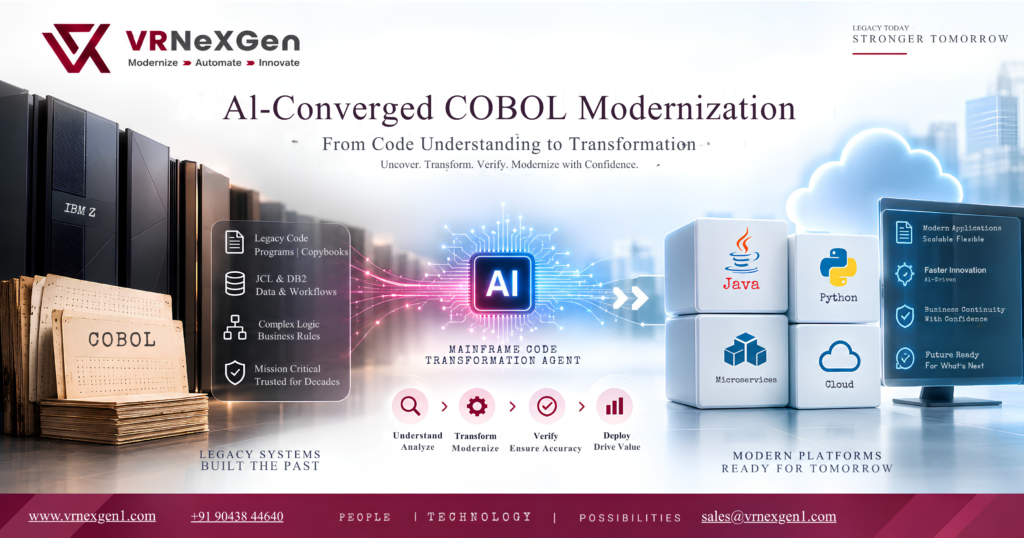
AI-Converged COBOL Modernization: From Code Understanding to Transformation
How a Mainframe Code Transformation Agent moves legacy COBOL to Java microservices or Python — and why verification, not translation, is the hard part
Introduction: The Reality of AI-Converged COBOL Modernization
Somewhere in a data center right now, a COBOL program written before the moon landing is settling a payment, approving a claim, or calculating a pension. That isn’t nostalgia — it’s infrastructure. A Micro Focus survey of over 1,100 IT professionals across 49 countries found that more than 800 billion lines of COBOL are still running in production today, up from roughly 220 billion just a decade ago, and 92% of the organizations running it call those applications strategic to their future IT plans. The UK’s Department for Work and Pensions alone runs about a billion lines of code across its systems to distribute £195 billion a year in payments, much of it on infrastructure over 40 years old. COBOL didn’t lose the argument for modernization; it simply became too load-bearing to touch carelessly.
That’s the real starting condition for any COBOL modernization effort: not “rewrite the old thing,” but “safely understand and re-platform something the business cannot afford to get wrong.” This is exactly where AI-converged modernization — pairing large language models with a disciplined, agentic pipeline — is changing what’s actually possible, and it’s worth being precise about what an AI-driven Mainframe Code Transformation Agent should do, because the gap between the hype and the reality is where most of these projects still fail.
Why “Translate the Code” Was Always the Wrong First Step in COBOL Modernization
For decades, mainframe modernization meant one of two options: a manual, multi-year rewrite staffed by an ever-shrinking pool of COBOL specialists that converted COBOL syntax line-by-line into Java or C, producing code that compiled but was arguably harder to maintain than the original. Neither approach asked the question that actually matters: what does this program do, in business terms, and why?
The emerging consensus — visible in how both Anthropic and IBM are approaching this problem— is that modernization has to follow a reverse-engineer-first methodology. You cannot responsibly transform what you haven’t first understood, and a 40-year-old COBOL system’s real specification usually isn’t the requirements doc, which is long gone; it’s the code itself, along with every quirky edge case someone patched in during a Y2K fix or a regulatory change in 2003. A transformation agent’s job starts with recovering that lost specification, not with generating Java.
The Architecture of an AI-Converged COBOL Modernization Agent
A well-designed agent for this problem works in two connected phases, and the connective tissue between them — verification — is arguably the most important part.
Phase 1: Code Understanding in AI-Converged COBOL Modernization
The agent ingests the full codebase — programs, copybooks, JCL, embedded SQL — and builds a dependency graph: which programs call which, which copybooks are shared, where data flows in from VSAM files or DB2 tables, and where control flow does something non-obvious, such as a dynamic GOTO or an ALTER statement or an implicit type coercion. This is precisely the phase Anthropic has highlighted Claude Code compressing “from months to weeks to days and hours,” because a model that can read an entire codebase in context can trace execution paths and surface implicit couplings far faster than a human doing it file by file. The output of this phase isn’t code — it’s documentation: business rule extraction, a call graph, and a risk map of which modules are safe to touch first and which are landmines.
Phase 2: Code Transformation in AI-Converged COBOL Modernization
Using the dependency map, the agent translates the lowest-risk, most self-contained units first — utility paragraphs and copybooks before the programs that depend on them — targeting either Java microservices, when the goal is decomposing a monolith into independently deployable services, or Python, when the target is a more analytics- or automation-friendly runtime. Each translation carries forward the semantic details that transpilers historically lost: COBOL’s packed decimal arithmetic has to map to exact-precision types, not floating point; fixed-width record layouts become explicit schemas; PERFORM VARYING loops and ON SIZE ERROR handling have to preserve their original bounds and failure behavior, not an approximation of it.
The Part Everyone Skips: Provable Behavioral Equivalence
Here’s the honest caveat, and it’s an important one: a recent industry analysis comparing Anthropic’s and IBM’s COBOL modernization tooling concluded that neither vendor currently demonstrates “provable behavioral equivalence between legacy COBOL and migrated code” in production, and called it the market’s most pressing unmet need. Faster code understanding is a real gain, but as the same analysis put it, accelerating discovery alone just gets you to “faster discovery of a program that still fails” if the transformation step isn’t independently verified.
Accelerating code analysis alone risks faster discovery of a program that still fails.
This is why an AI-converged agent has to treat testing as a first-class phase, not an afterthought: generating characterization tests from the original COBOL’s observed behavior, running differential tests that feed identical inputs to both the legacy and the transformed system and diff the outputs, and escalating anything ambiguous — especially around money, regulatory logic, or undocumented edge cases — to a human reviewer rather than guessing. Hence agent-based validation with human escalation paths, sitting between forward engineering and deployment, not bolted on at the end.
What’s Actually Working — and Where the Failure Rate Comes From
The proof points are real but bounded. Morgan Stanley used AI tooling to work through more than 17 million lines of legacy code, cutting week-long coding tasks down to half a day. Toyota converted more than 40 million lines of COBOL to Java using AWS’s modernization tooling. That shows reports reverse-engineering over 900,000 lines of legacy code in three weeks at roughly a quarter of the projected cost of a traditional approach. These aren’t marketing numbers pulled from a demo — they’re production outcomes from multi-agent pipelines that treat understanding, transformation, and validation as separate, auditable stages.
At the same time, Gartner has warned that more than 70% of mainframe migrations started this year are on track to fail, largely because teams overestimate what a single model can do end-to-end and underinvest in the validation and change-management work around it. The lesson isn’t that AI can’t do this; it’s that “AI-converged” has to mean orchestrated, specialized agents — one mapping dependencies, one handling compliance and security context, one generating tests, one doing the actual translation — with humans making the calls that carry business risk, not one model asked to modernize a mainframe in a single prompt.
The Real Shift in AI-Converged COBOL Modernization
COBOL modernization used to be a binary choice between “rewrite everything and pray” and “leave it alone until the last person who understands it retires.” AI-converged modernization — code understanding first, incremental transformation second, provable equivalence enforced throughout — is what turns that into a project with a plan, a timeline, and a way to know it worked before it goes live. The organizations getting real results in 2026 aren’t the ones that found a magic translate button; they’re the ones that built the discipline of verification into the agent itself.
Conclusion: The Future of AI-Converged COBOL Modernization
AI-converged COBOL modernization transforms modernization into a controlled, verifiable engineering process.
Ready to Modernize Your COBOL Systems?
Start your AI-converged COBOL modernization journey with VRNeXGen. Transform legacy systems into scalable, future-ready platforms with confidence.
📩 Contact / Mail Section
📧 Email: sales@vrnexgen1.com
📞 Phone: +91 90438 44640
🌐 Website: https://vrnexgen1.com