IBM ADDI Tutorial: Visualizing Legacy COBOL Applications for Faster Mainframe Modernization
Introduction
One of the biggest challenges in mainframe modernization is understanding decades-old legacy applications. Many enterprise systems running on IBM Z consist of thousands of COBOL programs, CICS transactions, JCL jobs, DB2 databases, and interconnected dependencies. Without proper documentation, understanding these applications can feel like reading a massive book without an index.
This is where IBM Application Discovery and Delivery Intelligence (ADDI) becomes invaluable. IBM ADDI helps organizations visualize complex application landscapes, discover hidden dependencies, and analyze business logic faster through automated application intelligence.
In this tutorial, we explore how IBM ADDI transforms traditional legacy code analysis into a visual and data-driven process, enabling developers, architects, and modernization teams to understand COBOL applications more efficiently.
What is IBM ADDI?
IBM Application Discovery and Delivery Intelligence (ADDI) is an enterprise application analysis platform designed for IBM Z environments. It automatically scans application source code, metadata, databases, and runtime relationships to create visual representations of application structures.
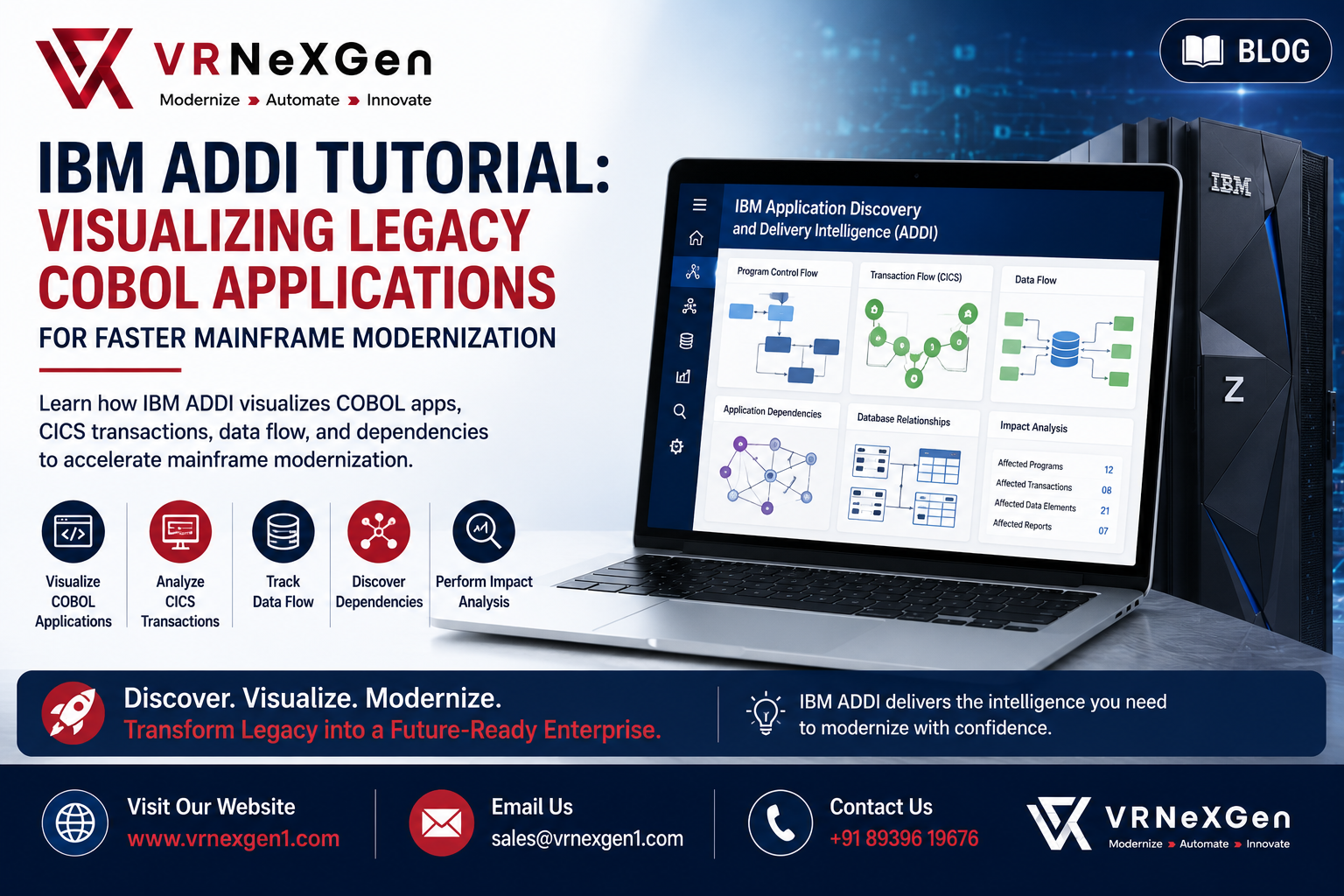
Instead of manually tracing program calls across thousands of lines of COBOL code, ADDI generates graphical maps showing:
- Program Control Flow
- Transaction Flow
- Data Flow
- Application Dependencies
- Database Relationships
- Impact Analysis
This significantly reduces the time required to understand and modernize legacy applications.
Why Legacy Application Analysis Is Difficult
Many organizations still operate business-critical applications developed decades ago.
Common challenges include:
Lack of Documentation
Original system documentation is often outdated or missing entirely.
Complex Program Dependencies
A single CICS transaction may invoke multiple COBOL programs, which in turn access DB2 tables, VSAM files, and external services.
Knowledge Loss
Retiring mainframe experts take years of application knowledge with them.
Slow Modernization Projects
Teams spend months analyzing applications before modernization efforts can even begin.
IBM ADDI addresses these challenges by automatically discovering and documenting application relationships.
How IBM ADDI Converts Code into Visual Diagrams
One of ADDI’s most powerful capabilities is converting source code into easy-to-understand visual models.
Program Control Flow Visualization
Program Control Flow diagrams display how programs interact within an application.
Instead of searching manually through thousands of lines of COBOL code, developers can quickly identify:
- Entry points
- Program calls
- Nested dependencies
- Processing paths
This visual representation accelerates troubleshooting and application understanding.
Example
A developer investigating a CICS transaction can immediately identify:
- The transaction entry point
- Invoked COBOL programs
- Downstream program calls
- Related database interactions
Without ADDI, this process could take days of manual analysis.
Transaction Flow Analysis
Transaction Flow diagrams help teams understand how business transactions move through the application.
ADDI automatically identifies:
- CICS transactions
- Associated programs
- Data processing sequences
- Business workflow execution
This provides a complete view of transaction processing logic.
Benefits
- Faster root cause analysis
- Simplified onboarding
- Improved application documentation
- Reduced operational risk
Data Flow Visualization
Data Flow analysis is essential for modernization and compliance projects.
ADDI tracks how data moves across:
- COBOL programs
- DB2 tables
- VSAM files
- Batch processes
- Online transactions
Visualization helps organizations understand exactly where data originates, how it is transformed, and where it is consumed.
This capability is especially useful when planning:
- Cloud migrations
- Application refactoring
- Data governance initiatives
- Regulatory compliance audits
Impact Analysis at the Data Field Level
One of the most valuable features demonstrated in IBM ADDI is Impact Analysis.
Before modifying a data field, developers need to understand:
- Which programs reference the field
- Which reports use the field
- Which transactions depend on the field
- Potential downstream effects
Why Impact Analysis Matters
Even a small change to a customer record field can affect:
- Online applications
- Batch jobs
- Reporting systems
- External integrations
ADDI automatically identifies these dependencies and presents them visually.
Benefits Include
- Reduced production failures
- Faster change management
- Improved release planning
- Enhanced system reliability
For enterprises managing large-scale legacy systems, this capability significantly lowers modernization risk.
Accelerating Mainframe Modernization with IBM ADDI
Modernization projects often fail because organizations underestimate application complexity.
Before migrating, refactoring, or rewriting applications, teams must first understand the existing environment.
IBM ADDI helps modernization teams:
Discover Hidden Dependencies
Applications often contain undocumented relationships accumulated over decades.
ADDI automatically uncovers:
- Program-to-program dependencies
- Database relationships
- Shared resources
- Transaction flows
Improve Migration Planning
Whether migrating to:
- Java
- Microservices
- Cloud-native architectures
- Hybrid cloud platforms
ADDI provides the application intelligence needed to make informed modernization decisions.
Support AI-Powered Modernization
As Generative AI and AI-assisted code transformation gain adoption, accurate application discovery becomes increasingly important.
Tools such as IBM watsonx Code Assistant for Z rely on deep application understanding to:
Analyze business logic
Generate modernization recommendations
Support COBOL transformation
IBM ADDI serves as a critical foundation for these modernization initiatives.
Key Benefits of IBM ADDI
Organizations using IBM Application Discovery and Delivery Intelligence gain several advantages:
Faster Application Understanding
Visual diagrams reduce manual code analysis effort.
Improved Developer Productivity
Teams spend less time tracing dependencies and more time delivering value.
Reduced Modernization Risk
Impact analysis minimizes unintended consequences during system changes.
Better Documentation
Automatically generated application maps improve knowledge sharing.
Accelerated Transformation Projects
Application discovery speeds up cloud migration and modernization planning.
Best Practices for Using IBM ADDI
Analyze Critical Applications First
Start with business-critical systems that have the highest modernization priority.
Maintain Continuous Discovery
Regular scans ensure application documentation remains current.
Combine ADDI with Modernization Tools
Use ADDI alongside:
- IBM watsonx Code Assistant for Z
- IBM Z Open Editor
- Application modernization frameworks
This creates a comprehensive modernization strategy.
Conclusion
Understanding legacy applications is one of the biggest barriers to successful mainframe modernization. IBM Application Discovery and Delivery Intelligence (ADDI) simplifies this challenge by transforming complex COBOL applications into visual, navigable models.
Through Program Control Flow, Transaction Flow, Data Flow visualization, and Impact Analysis, ADDI enables organizations to understand large-scale applications faster, reduce modernization risks, and accelerate digital transformation initiatives.
For enterprises planning COBOL modernization, cloud migration, or AI-assisted application transformation, IBM ADDI provides the visibility and application intelligence needed to make confident modernization decisions.
Frequently Asked Questions
What is IBM ADDI?
IBM Application Discovery and Delivery Intelligence is a software solution that helps organizations visualize, analyze, and understand complex mainframe applications.
How does IBM ADDI help modernization projects?
It identifies dependencies, visualizes application flows, and performs impact analysis to reduce modernization risks.
Can IBM ADDI analyze COBOL applications?
Yes. IBM ADDI is specifically designed to analyze COBOL-based applications running on IBM Z environments.